

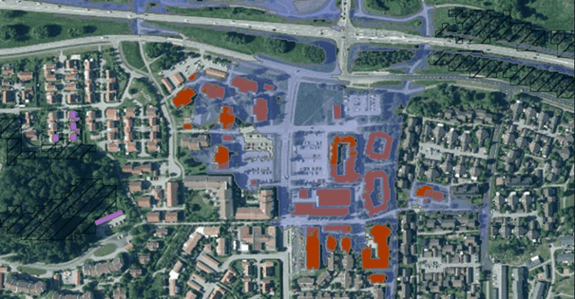
Climate Risks for Real Estate
Climate change is already affecting real estate, infrastructure, and urban planning. For property owners, banks, insurance companies, investors, and public sector actors, there is a growing need to understand and manage physical climate risks.
Here, we compile knowledge, analyses, and decision-making resources on how geographic risks such as flooding, erosion, landslides, and rockfalls can affect real estate and businesses.
Latest insights
- Metria Insights Finance: Climate Risk in Practice
- Metria Insights Insurance: Climate Risk in Practice
- Report: Climate Risks for Real Estate in Sweden
- New analyses and articles are published on an ongoing basis
What are physical climate risks?
Physical climate risks are risks that arise when climate change affects land, water, buildings, and infrastructure. Examples include rising sea levels, torrential rain, flooding, erosion, landslides, and mudslides.
These risks vary depending on geographic location, soil conditions, and the design of the built environment.
Understanding the risk landscape often requires a combination of property information, geodata, and geographic analyses.
Common climate risks for properties
Flooding
Torrential rain, high water flows, and rising sea levels can affect both properties and infrastructure.
Erosion
Changing water levels and increased precipitation can lead to erosion that affects soil stability.
Landslides and landslips
Some areas are more susceptible to ground movements than others, especially in combination with changing climate conditions.
Changing soil conditions
Increased precipitation and changes in groundwater levels can affect buildings and infrastructure over time.
Why are climate risks important?
Physical climate risks are influencing an increasing number of decisions related to:
- real estate investments
- lending
- insurance
- urban planning
- property management
- sustainability efforts
For many organizations, it’s a matter of understanding which properties are affected, the extent of the exposure, and what measures can be taken to mitigate the risks.
How is geographic decision support used?
Geographic analyses make it possible to identify risks at the property level and analyze larger real estate portfolios.
Using geodata and property information, organizations can:
- map exposure to various climate risks
- identify particularly vulnerable areas
- prioritize actions
- strengthen risk management and decision-making
Further Reading
Report: Climate Risks for Real Estate in Sweden
Guide:
Metria Insights
- Metria Insights Finance: Climate Risk in Practice
- Metria Insights Insurance: Climate Risk in Practice
Article: Three Insights from Discussions on Climate Risks inthe Banking Sector
Article: What is the difference between climate risk, flood risk and geographic risk?
Article: How Climate Risk Data Enhances Decision - making in Finance
Article: Metria Strengthens Climate Risk Assessment Through Membership in the Credit Association
Article: Flood Risk—How Can Geodata Identify High-Risk Areas?
Article: Climate Risk and Real Estate Valuation—How Credit Risk Is Affected in the Long Term
Article: Flood risk from waterways and blue spots—what should be included in the valuation model?
Related solutions
Climate Analysis: Identify and analyze climate risks for properties and geographic areas.
Property Information Quality-assured property data for analysis and decision-making.
Banking, Finance, and Insurance: Real estate data and geographic analyses for risk management and credit processes.
Sustainability with Geodata and Real Estate Data
Metria combines geodata, property information, and analysis to create concrete decision-making tools for sustainability
Why Metria?
Metria combines real estate information, geodata, and geographic analyses to create decision-making tools that help organizations understand and manage climate risks.
With extensive experience in geographic information and analysis, we support banks, insurance companies, property owners, municipalities, and other organizations that need to make well-informed decisions in a changing world.
Would you like to understand how climate risks affect the properties in your business?
Schedule a meeting with our experts to discuss your risk profile, analysis needs, and possible solutions.
E-post: mikael.carlestal@metria.se
Tel. +46 72 1433 222
E-post: johan.hedman@metria.se
Tel. +46 10 121 84 46
Vad är en fysisk klimatrisk?
En fysisk klimatrisk är en risk som uppstår när klimatförändringar påverkar mark, vatten, byggnader eller infrastruktur, exempelvis genom översvämning, erosion eller ras.
Hur påverkar klimatrisker fastigheter?
Klimatrisker kan påverka fastigheters värde, användbarhet, försäkringsvillkor och långsiktiga riskbild.
Vilka verksamheter behöver analysera klimatrisker?
Banker, försäkringsbolag, fastighetsägare, investerare, kommuner och samhällsbyggnadsaktörer är några exempel på verksamheter som arbetar med klimatriskanalyser.
Hur kan geodata användas för att analysera klimatrisker?
Geodata gör det möjligt att analysera geografiska förutsättningar, identifiera utsatta områden och bedöma risker på fastighets- eller portföljnivå.