

How are climate risks for buildings analyzed?
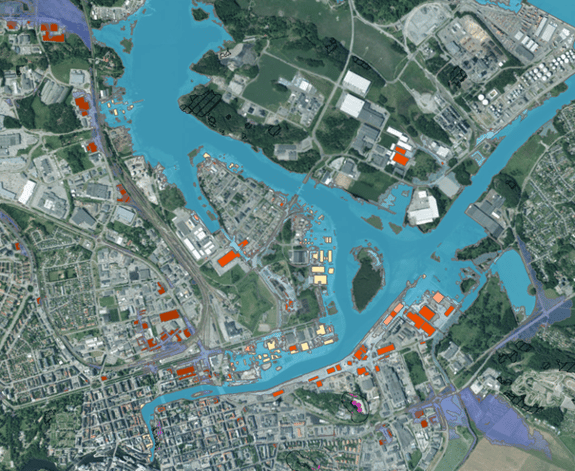
Climate risks to real estate are analyzed by combining real estate information, climate data and geographical analysis in GIS. This allows organizations to identify risks such as flooding, erosion and landslides at both the property and portfolio level.
Introduction to the report
Climate change is increasingly affecting real estate. Increased precipitation, rising sea levels and changing soil conditions mean that risks need to be analyzed more systematically.
For banks, insurers, energy companies and property owners, it is a matter of understanding:
- which properties are at risk
- how risks affect value and investments
- how risks change over time
What are climate risks for real estate?
Climate risks are risks arising from changing climate conditions.
Common examples are:
- flooding due to heavy rainfall or high water levels
- erosion along coasts and rivers
- landslides in unstable ground
- impacts from extreme weather
These risks can affect buildings, land and infrastructure.
Climate risks are often analyzed using geographical analysis in GIS.
Find out more about how GIS and spatial analysis work →
How is a climate risk analysis done?
A climate risk analysis is carried out in several steps, combining different data sources.
1. collecting property data
Real estate information is used to identify:
- property boundaries
- buildings
- addresses
- coordinates
This makes it possible to analyze risks at the property level.
2. analyze geographical conditions
Geodata is used to understand how risks affect different areas.
Example:
- elevation data (terrain and water flows)
- soil and geological data
- hydrological data
3. linking climate data
Climate data is used to analyze:
- precipitation
- water levels
- future climate change
4. Combining data in GIS
By combining data layers in GIS, organizations can identify:
- properties in risk zones
- geographical patterns
- concentration of risk
To analyze risks at a detailed level, real estate information is often used.
Find out more about what real estate information is and how it is used →
Example: climate risk analysis in practice
A bank can analyze its credit portfolio by:
- linking properties to geographical data
- identifying which properties are located in flood zones
- analyzing how much of the portfolio is affected
The result is a better decision-making basis for credit risk.
Climate risk analysis at property and portfolio level
Property level
- identify risk for individual buildings
- analyze impact on investments
Portfolio level
- analyze concentration of risk
- compare regions
- identify exposure
Want to know more?
Want to analyze climate risks in your business?
The combination of real estate data and spatial analysis makes it possible to identify risks at the property level. See how spatial analysis is used in practice →
Why is climate risk analysis important?
Climate risk analysis makes it possible to:
- reduce risk in investments
- prioritize actions
- make more informed decisions
- meet regulatory requirements
Executive summary
Climate risks for real estate are analyzed by combining real estate information, climate data and geographical analysis.
By using GIS, organizations can identify risks, analyze portfolios, and better inform decisions in a changing climate.
Want to analyze climate risks in your real estate portfolio or identify risk areas?
Contact us and we will show you how it can be done in practice.
Related articles and guides
- What is a climate risk analysis
- Guide: Climate risk analysis with geodata
- What is GIS and spatial analysis
- What is real estate information
About Metria
Metria are experts in real estate information and geographic data. We offer digital solutions and services in GIS, remote sensing, geodata and real estate information to support analysis and decision-making.
För mer information
About Metria
Metria offers digital solutions and services in GIS, geodata, real estate information. Our offer covers the entire chain from identifying the customer's needs for geodata, real estate and business information to collecting, analyzing and visualizing data to create insights that lead to smarter, safer and greener decisions.
Since spring 2022, Metria has been part of Spir Group, a Nordic group with approximately 260 employees in Norway and Sweden.
Spir Group is a Nordic company that, by collecting and making information available between consumers, public and private sectors, we simplify processes that are unnecessarily complex.
Spir Group is the parent company and visionary force behind several software subsidiaries, all dedicated to delivering business-critical technology that sustains and develops society.
Our customers range from real estate agents, banks, insurance companies, appraisers, real estate developers, media companies, builders, property owners, engineers, energy companies to building material manufacturers.
We are more than 260 colleagues with deep domain and technology expertise. Spir Group does more than just collect and share information. We enable innovation and growth that strengthens trust between people, businesses and society.
More information about Spir Group is available at www.spirgroup.com.