
In the early stages of a project, many of the decisions that will later be difficult to change are shaped. Volumes are placed, entrances are oriented and the relationship to the surroundings is established. At the same time, it is often precisely at these stages that the data is most transparent.
The topography is one of the most fundamental characteristics of the site. It affects how the building meets the ground, how movements are organized and how the project is perceived in its context. Understanding the shape of the terrain early on is therefore not a technical detail - it is part of the architectural process.
When the terrain becomes clear at the right stage
In many projects, the first sketches are produced with a general idea of the site. Only later, when more detailed data is used, do differences in levels and slopes become more apparent. This may mean that solutions need to be adjusted or reworked.
When elevation information is available at the design and sketch stage, it is easier to make reasonable assessments from the outset. It is not about millimeter precision, but about understanding the overall structure of the terrain and how it affects placement and principle solutions.
Contour lines - an easy-to-interpret entry point to topography
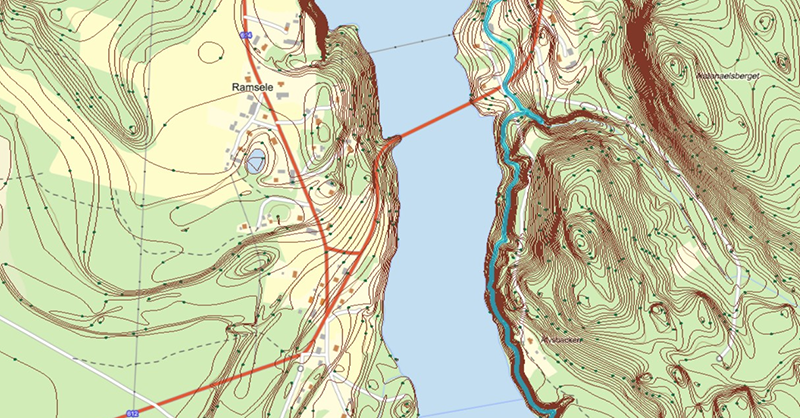
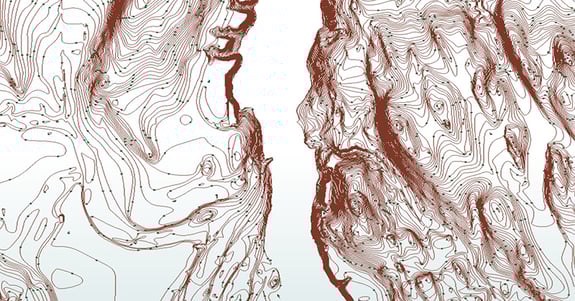
Contour lines are one of the most established and easily interpreted ways to visualize terrain. They quickly provide a picture of slopes, ridges and valleys and work well in combination with maps and orthophotos.
In the early stages, contour lines can be used for example for:
- overall volume studies and placement in hilly terrain
- early assessment of level differences
- discussion of entrance locations and accessibility principles
- dialog material in presentations and consultations
They provide an instant readability that makes it easy to have a joint discussion about the site conditions.
Multiple forms of elevation data - different purposes
At the same time, contour lines are only one part of the elevation data that can be used in architectural and planning processes.
Terrain shading can provide a more visual and intuitive experience of landscape form, especially in larger contexts. Grid-based elevation data and laser data allow for more advanced processing and further analysis in GIS and planning environments.
The choice of data depends on the stage of the project and the research question. At an early stage, a readily available and general data set may be sufficient to understand the direction. At later stages, more detailed elevation data may be needed for in-depth analysis.
Part of the architect's toolbox
Access to geographical information has changed in recent years. Elevation data and other location data that previously required special orders or external investigations are now often available digitally and can be used directly in the early analysis of projects.
This means that elevation information is not just a technical aid in design, but a natural part of the architect's toolbox - even when the first ideas are being formulated.
Including the terrain from the start strengthens both design and feasibility. When the topography of the site is clarified early on, the conditions for solutions that are adapted to the context, rather than corrected afterwards, increase.